


Glass bottles still play a significant role in the packaging of various products that require effective protective properties—including spirits, wine, craft beers, premium soft drinks, and even some medicines. The basic production sequence hasn’t changed much in decades, but 2026 brings sharper focus on cutting weight, pushing recycled content higher, and dialing down energy use per container. Plants run tighter tolerances now, and the push for lighter bottles that still handle filling-line abuse and shelf pressure has become table stakes rather than a nice-to-have. What follows lays out the current process in detail, flags the practical shifts happening right now, covers the defects that still show up, and gives a clear-eyed look at what matters when picking a supplier.
What Raw Materials Are Used to Make Glass Bottles Today?
Silica sand remains the main structural ingredient, usually sitting around 70% of the batch weight. Soda ash acts as the flux that brings the melting point down to something workable in large furnaces, while limestone and dolomite supply the stabilizing oxides that keep the glass from devitrifying or leaching under normal use. Feldspar and a handful of other minerals get added in smaller amounts to fine-tune viscosity curves and help control color consistency across long runs.
Recycled glass—cullet—has moved from occasional additive to core component in most operations. Depending on the color family and the quality of incoming material, cullet routinely accounts for 30% to as high as 80% of the batch. The energy math is straightforward: roughly 3–5% less heat input for every 10% increase in cullet because it already carries the heat history of a previous melt. That translates to measurable drops in natural-gas consumption and CO₂ from both fuel and raw-material decomposition. For tinted bottles, iron compounds deliver the standard amber and green shades, cobalt handles blue tones, and sulfur-based chemistry produces the deep browns that block UV for light-sensitive liquids. Everything gets weighed on high-accuracy scales, blended in fast mixers to avoid layering, and fed steadily into the furnace. Even small inconsistencies in moisture or particle sizing can create cords or stones later, so most plants check those parameters several times a shift.
Step-by-Step: The Modern Glass Bottle Manufacturing Process
Batch Preparation and Mixing
Automated scales dose ingredients with precision that leaves little room for variation. High-intensity mixers run short, aggressive cycles to produce a uniform blend. Any segregation at this point shows up downstream as localized composition differences that lead to refractory wear or visual defects in the final container.
Melting and Refining
The batch enters a continuous furnace—regenerative, oxy-fuel, or increasingly hybrid electric setups—where temperatures hold steady between 1500 and 1600 °C. The melt takes 24 to 48 hours to fully homogenize as raw materials dissolve and most volatiles escape. Fining agents accelerate bubble removal, leaving a clearer, more uniform glass. From there the melt flows to the forehearth, cooling in controlled stages until it reaches the right working viscosity, typically 1100–1200 °C, for consistent gob formation.
Gob Formation and Delivery
Shear blades cut gobs from the feeder stream at precise intervals. Weight control is critical—modern lines hold tolerances of ±1–2 grams because even small deviations throw off wall distribution in the finished bottle. Delivery chutes and timing systems keep each gob centered and at stable temperature before it drops into the blank mold.
Forming
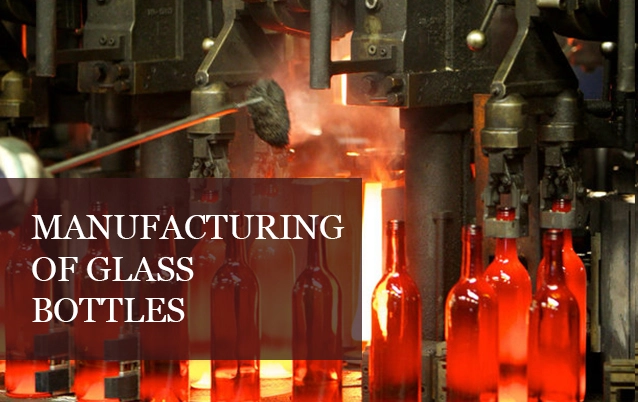
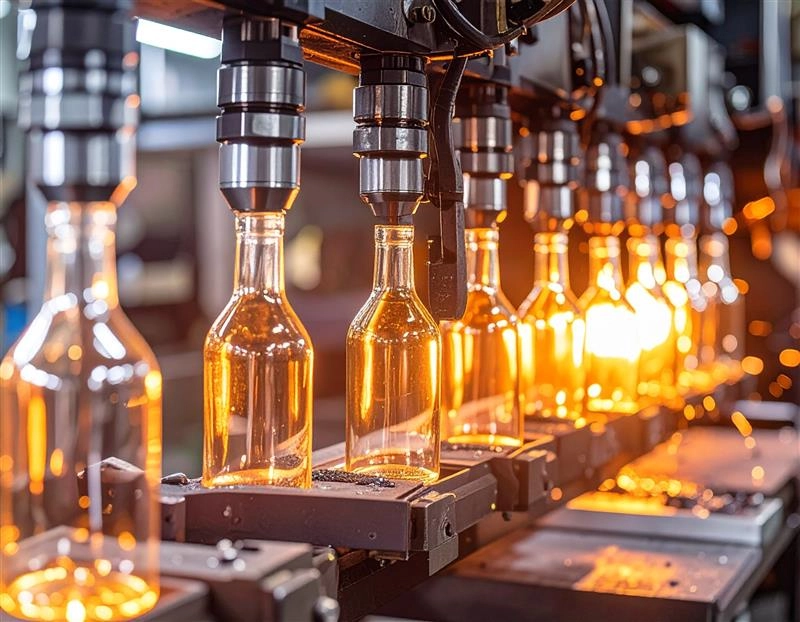
Most narrow-neck bottles still come from one of three methods. Blow-and-blow handles the bulk of standard beverage and liquor containers: initial air puff forms the finish in the blank, the parison inverts to the blow mold, and final blowing shapes the body. Press-and-blow works better for wider mouths. Narrow Neck Press and Blow (NNPB) now sees heavy use wherever lightweighting is the priority—precise pressing of the finish and shoulder lets walls thin out significantly while keeping axial load and internal pressure resistance intact.
IS machines with 10 to 20 sections run in parallel, cycling molds fast enough to hit thousands of units per minute. Mold cooling—air blasts or internal water channels—sets the shape quickly and limits thermal distortion over long production runs.
Annealing
Hot bottles enter the annealing lehr at 500–600 °C. The temperature drops gradually over 30–60 minutes to room level, relieving the internal stresses that would otherwise cause spontaneous failure days or weeks later. Lehr profiles get adjusted for bottle size, wall thickness, and glass color to avoid uneven stress patterns.
Cold End Processing: Inspection, Coating, and Packaging
Every bottle passes through automated inspection stations—high-resolution cameras, laser gauges, pressure testers—that catch dimensional drift, wall variation, surface checks, base issues, and pressure failures. Surface treatments, usually tin oxide followed by a polyethylene layer, reduce scratching and improve glide on filling lines. Printing or embossing happens here when needed, then bottles go onto pallets with protective layering for shipment.
2026 Key Trends Shaping Glass Bottle Production
Lightweighting keeps progressing. NNPB forming combined with better parison shaping and stress modeling lets many standard 750 ml wine bottles drop from 550 g down to 350–400 g. The containers still clear burst and top-load specs, but the savings show up in raw-material costs, freight, and line handling.
Cullet ratios continue rising. Many plants average over 50%, and some dedicated lines push past 80% for non-color-critical applications. Returnable systems, especially in beer and CSD, routinely deliver 20–40 refill cycles before final recycling, stretching material life and helping meet extended producer responsibility rules.
Furnace designs lean toward hybrid electric-gas or hydrogen-capable setups that cut direct emissions. AI vision systems and predictive models now drive defect rates below 0.1% in well-run facilities. Digital printing and short-run decoration options let brands customize without major line slowdowns.
Common Defects in Glass Bottle Production and How to Avoid Them
Stress cracks often trace back to uneven annealing or later thermal shock. Bubbles and inclusions come from trapped gases or poor fining control. Wall-thickness variation usually starts with inconsistent gob weight or mold-cooling issues. Heavy mold seams appear when molds wear unevenly or alignment shifts over time.
The strongest prevention stays upstream: consistent batch mixing, tight gob-weight control, scheduled mold maintenance, and carefully tuned lehr curves eliminate most problems before they reach the cold end. Inline rejection keeps scrap recycled immediately. Procurement teams gain confidence by asking for annealing data, capability studies, and sample test results covering pressure, thermal shock, and dimensional stability.
How to Choose a Reliable Glass Bottle Supplier in 2026
Price alone rarely tells the full story. Flexible minimum order quantities—down to several thousand units—matter for new launches or seasonal runs. Capability to handle specific neck finishes, deliver matched closures, and manage mold development on reasonable timelines separates capable suppliers from the rest.
Quality systems should include full traceability, food-contact compliance records, and routine provision of test documentation. Sustainability metrics—documented cullet usage, lightweight achievements, carbon footprint data—carry more weight as regulations tighten. Suppliers that handle both bottles and closures in-house reduce the chance of mismatched components and the resulting leakage or torque issues on filling lines.
Yantai Original Package Co., Ltd.
Yantai Original Package Co., Ltd. concentrates on closures and supporting glass containers for beverages, spirits, and food packaging. With more than eight years focused on export markets, the company supplies aluminum caps, aluminum-plastic combination caps, plastic caps, metal twist-off closures, and a broad lineup of glass bottles covering wine, beer, spirit, and general beverage formats. Low minimum order quantities, custom logo options, and coordinated bottle-closure development form the core strengths. Integrated design, tooling, production, and quality control help deliver packaging that maintains seal integrity and simplifies logistics while factoring environmental considerations into material selection and processing.
Conclusion
The manufacturing process of glass bottles still follows the high-temperature chemical reactions and precise molding techniques that have been used for generations. However, by 2026, the industry has undergone significant changes compared to a few years ago. Factories usually increase the recycling of broken glass, produce containers that are significantly lighter, and implement stricter control measures to keep the defect rate low and energy consumption within a controllable range. For brands and buyers, understanding these actual situations helps them more easily identify suppliers that can provide stable performance, meet increasingly strict environmental standards, achieve cost-effective expansion without sacrificing quality or compatibility. The containers produced from these production lines still offer unparalleled protection and recyclability – as the pressure for sustainability in various fields continues to increase, these advantages are becoming increasingly difficult to ignore.
FAQs
How are glass bottles made with high recycled content without losing quality?
High cullet levels work when incoming material gets sorted tightly by color and cleaned of contaminants, then processed with adjusted fining and redox balance. Current plants regularly turn out bottles containing 50% or more cullet that hold up identically to virgin material in strength, clarity, and chemical stability.
What causes cracks in glass bottles during production, and how can buyers prevent them?
Cracks most commonly develop from residual stress after uneven annealing or from thermal shock during filling or sterilization. Optimized lehr profiles and controlled cooling rates prevent the majority of cases. Buyers should request annealing curve documentation and run sample thermal shock tests to confirm suitability for intended conditions.
Why choose lightweight glass bottles for beverage packaging?
Lightweight bottles cut material use by 15–35%, reduce transport-related emissions, lower melting energy, and improve handling on high-speed lines—all while still meeting burst pressure and vertical load requirements through refined forming methods like NNPB.
How do I ensure bottle and cap compatibility to avoid leaking?
Matching neck finish dimensions, thread geometry, and sealing surfaces exactly is the foundation. Suppliers producing both components normally conduct torque, vacuum, and pressure-decay tests on assembled pairs. Paired sample certification and leak-test data under realistic conditions help eliminate mismatch risks.
What trends in glass bottle manufacturing should brands watch in 2026?
Ongoing lightweighting, steadily increasing cullet ratios, hybrid low-emission furnaces, near-zero-defect AI inspection, and wider use of returnable systems stand out as the main directions. Each delivers tangible reductions in cost and carbon footprint while strengthening compliance and brand sustainability positioning across beverage and spirits segments.


