


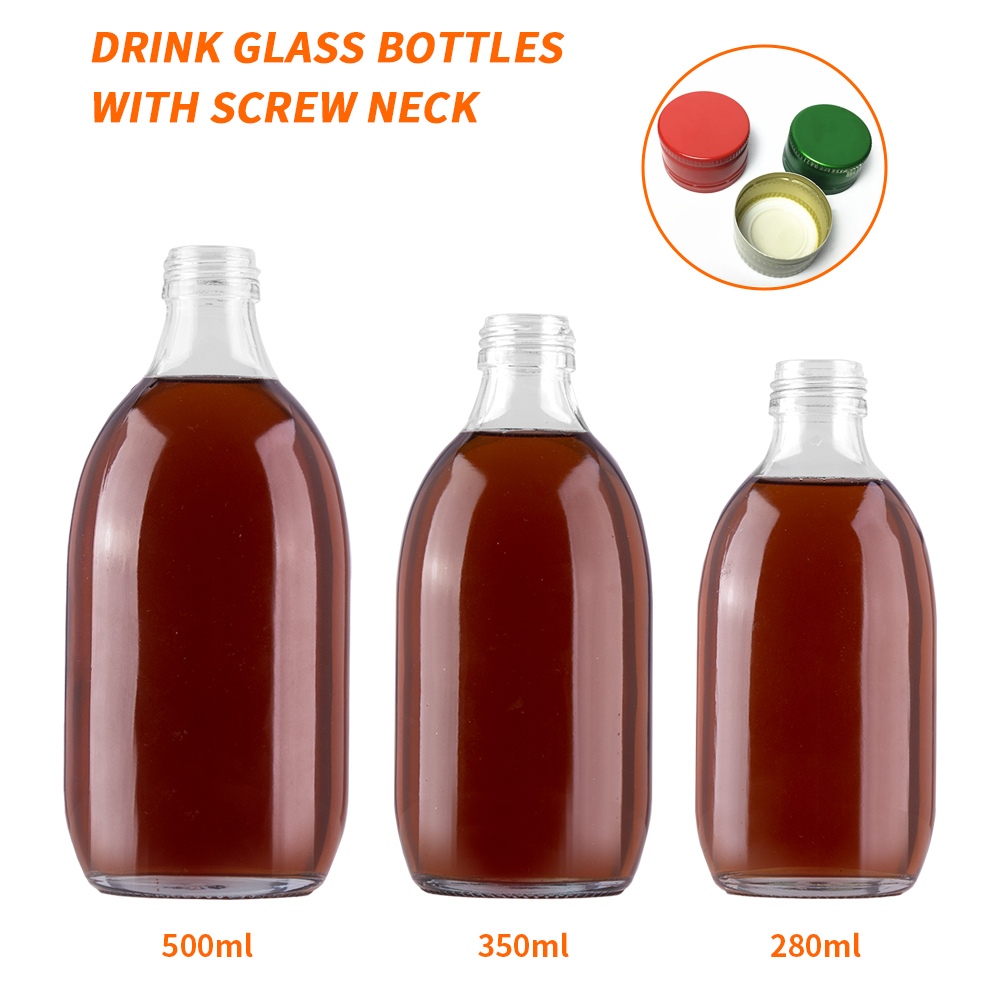
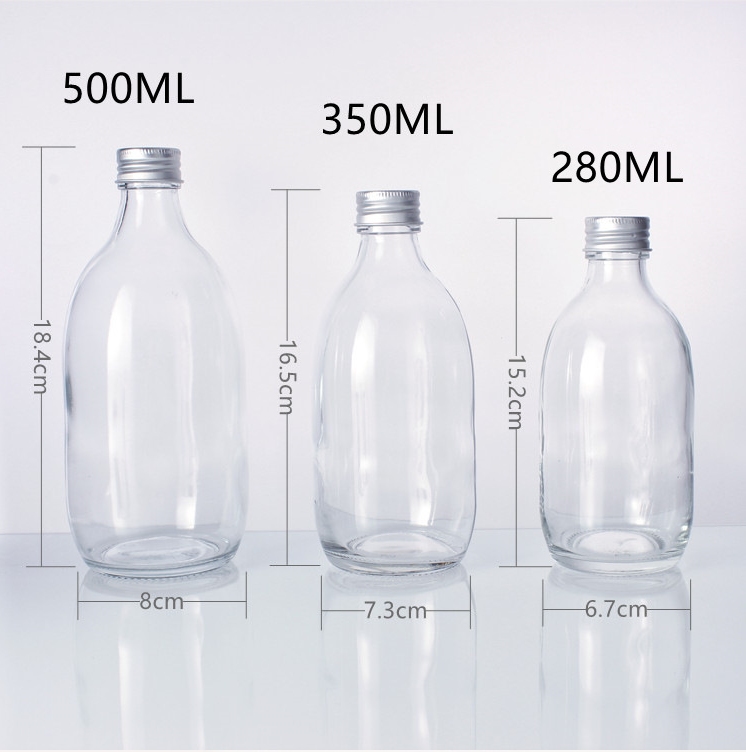
Before asking for a beverage bottle price, give the supplier a description of the drink. I’d include the filling method in that first message too. A photograph of clear glass and an aluminium cap can’t answer questions about your drink or the way it will be filled. The catalog offers a choice of 280 ml or 350 ml if you’re looking below half a litre, plus a 500 ml version. Beside each, the cap reference reads 28×16 mm. You can quote those details while asking the supplier to resolve what the photograph leaves unanswered.
How will you compare the three capacities?
Your intended selling volume gives you a reason to prefer one over another. The three options are all described as flint glass, which means clear glass. There is no recommendation on the page assigning a particular size to a particular drink.
Put the sample beside your product plan
If two sizes of glass beverage bottles remain on your shortlist, get samples of both. You may find that the label layout you liked on the larger sample needs another look on the smaller one. I’d rather make that comparison with bottles on the desk than depend on scaled images. Holding the sample and turning it around gives you a view the artwork alone can’t provide.
Does the listed cap settle the closure choice?
The 28×16 mm reference is worth keeping in your sample request. It tells the supplier which catalog combination you’re referring to. We don’t yet have a complete neck finish or a specified liner from that page, though.
Clarify the height before ordering
There is a detail to sort out when moving from the catalog to the website. The 28 mm aluminium beverage cap page lists heights of 16.5, 17 and 18 mm, rather than 16 mm. I’d ask which exact cap is being proposed for this bottle. A similar nominal diameter isn’t enough to treat these as interchangeable.
Ask about the capping method at the same time. Is the proposed closure ready to screw on, or does it require a different application process? The bottle photograph doesn’t settle that either. Your bottling team needs an answer before assessing the sample. Include the equipment details in this discussion, while a change is still possible without revisiting approved artwork.
What should your filling team add to the enquiry?
The word “beverage” covers more than the supplier can reasonably infer from a bottle photo. Explain whether it contains carbonation and what happens during filling. Include the temperature and the equipment you intend to use.
Keep unconfirmed applications out of the order
If you need hot filling or a heat treatment, say so in the enquiry. There is nothing on the catalog page confirming that these bottles are suitable for either. Nor is there a bottle pressure rating to quote. A carbonated drink therefore needs further verification; the word “beverage” shouldn’t be read as approval for that use.
The liner still needs a decision as well. Rather than naming one without the relevant information, ask the supplier what it proposes for your liquid and sealing surface. Have that choice recorded in the quotation. It gives you something definite to review if the closure changes during sampling.
For bottle neck confirmation, the supplier asks for a drawing, or a bottle sample when exact dimensions aren’t available. Label it with the chosen capacity so there is no confusion about which bottle was checked. With two sizes in the order, I’d keep two approval records, even though the cap reference is shared.
When is the pack ready for artwork and carton approval?
After the bottle and cap have been tried together, you’ll have a more useful sample for the designer. A cap-height decision still outstanding means its print area is outstanding too.
Check more than the digital mock-up
Discuss the cap color, top logo and side printing on the chosen closure. An editable artwork file and a color reference belong with that request. I’d leave final print approval until the size is settled, rather than have the designer revise a finished layout to suit another height.
Then look at the label on filled glass. Does it leave the closure area clear? Look closely at the edges for lifting or bubbles, and check whether you can read the text and scan the barcode. If something needs adjusting, send the designer and bottling team the same sample notes. The sample needs to look right after the label has actually been applied.
The carton review should use that closed bottle too. The packer will need to know the filled weight as well as how many you want in each case. Put the samples into the proposed arrangement, using the planned separation between them. On unpacking, check where the labels or caps have rubbed and whether the bottles could move. I’d repeat this for each capacity being bought. There is no carton specification for this range on the catalog page to copy instead of doing that review.
Who can help with the bottle and cap enquiry?
For this enquiry, Yantai Original Import and Export Co., Ltd. can discuss the aluminium caps it manufactures alongside its glass bottle supply and related cartons. Its matching process uses drawings or samples to identify the required closure. That is useful when the catalog has given you a starting reference but left the finish and liner unresolved.
Send the quantities broken down by capacity, with the cap reference and filling details attached. Include the artwork and carton requirement. You can then request prices for the identified parts and ask which samples are needed to assess the cap and liner. Don’t carry over an MOQ or delivery date from another product enquiry; leave those as questions for this order until the supplier confirms them.
Conclusion
Before signing off the purchase, put the finished sample beside the drawings and check that they describe the same pack. Here, the catalog starts the discussion with three capacities and a 28×16 mm cap. Sampling is where you resolve what remains open, with your filling team involved before the order goes ahead.
FAQs
What sizes can I enquire about from this catalog page?
You can ask about 280 ml or 350 ml, or choose the 500 ml version. All three are described as flint glass. Quote the chosen capacity when requesting the drawing and sample.
Can I substitute another 28 mm cap?
Not on diameter alone. Quote the catalog’s 28×16 mm reference and ask the supplier to check any alternative against the complete neck finish and sample.
What if I plan to fill a carbonated drink?
Raise that before ordering. You won’t find a pressure rating for this range on the catalog page. Ask the supplier to establish whether the proposed bottle and closure can be approved for your conditions.


